
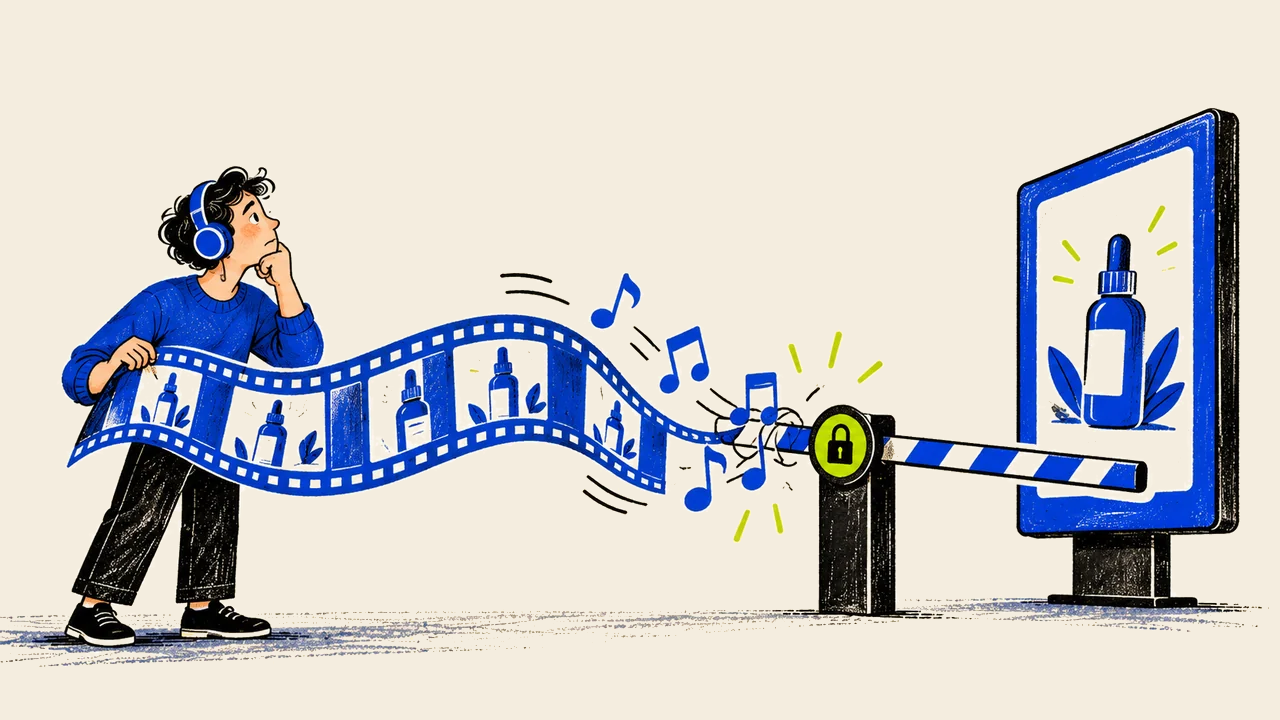
The cut lands on the beat and the product finally looks as though it belongs in the sequence. I understand why an editor would be reluctant to change the song at that point. The timing was built around it. A replacement may have the right permission and none of the feeling that made this version work.
That is why I would ask about music before everyone approves the edit. By the end, the team has several good creative reasons to want the permission question to go away. Those reasons do not answer it.
A sound in the app is only the beginning
TikTok's commercial-music guidance points brands towards its Commercial Music Library for promotional content. Its library instructions also ask advertisers to consider the relevant region and usable placements. The practical implication is that a track should be checked against the planned use, rather than selected solely because it appears in a popular video. Commercial Music Library instructions.
A personal post, a brand promotion and an advertising campaign are different contexts. Music permission needs to fit the one being produced. TikTok's music guide also makes clear that its library clearance is for TikTok; it should not be treated as blanket clearance for another network. TikTok's music guide.
The same caution applies to a track supplied by a creator. It may sound original to the marketing team, but that does not establish who owns it or what permission accompanies it. A reassuring message is less useful than a record that identifies the track and the permitted use.
Think past the first upload
Consider a hypothetical product reel commissioned for TikTok. During approval, someone asks for an Instagram version. A week later, the sales team wants it on a landing page. Another colleague suggests paid promotion.
I can imagine the producer hearing “an Instagram version” as a small export request. Creatively, it might be. But the team has just changed where the music will appear, and that belongs in the decision. A video file travels more easily than the permission attached to its soundtrack.
Keep the exact track and its source beside the brief, with the destinations, organic or paid placements, territory and duration checked. Include the permission record and the person who will review later reuse. That gives the next editor something firmer than “we used it last time.”
When the intended scope is unclear, give the question to someone who can establish it. A platform approval screen cannot resolve every contractual or music-rights question.
Imagine the original editor is unavailable when the landing-page request arrives. The next person should be able to find the approved video, identify its music and see which destinations were checked. “The editor found it in the app” leaves them rebuilding the permission investigation from scratch.
Keep a link to the applicable terms or license record with the asset. Record when the check was made and what use was considered. If the team changes territory, placement or distribution, flag the asset for another review. This record is useful even when the answer is that broader use has not been established yet.
The brief can also identify a fallback track and the work required to substitute it. An alternative does not need to be edited in advance, but knowing where an appropriate option might come from helps the producer estimate the change honestly. A request described as “just export another version” can then receive a realistic answer about music clearance and editing time.
The useful record would be one the next editor can understand without arranging a meeting with everyone who made the first video. If it takes three people to remember where a track came from, the apparent convenience of choosing it in the app has been passed along as work for somebody else.
Give the editor a usable option
It helps to choose from music that already fits the brief. If the campaign will run across several channels, investigate a suitable cross-platform license before cutting everything to a TikTok-only track. Where permitted, retaining an editable project with separate voice, music and effects also makes later changes less painful.
A track with every convenient permission can still spoil the scene. Sound is part of the idea. Checking it early gives the editor time to find an option that works on both counts, while there is still room to change the rhythm. After approval, the same decision arrives with a deadline and a disappointed team attached.