
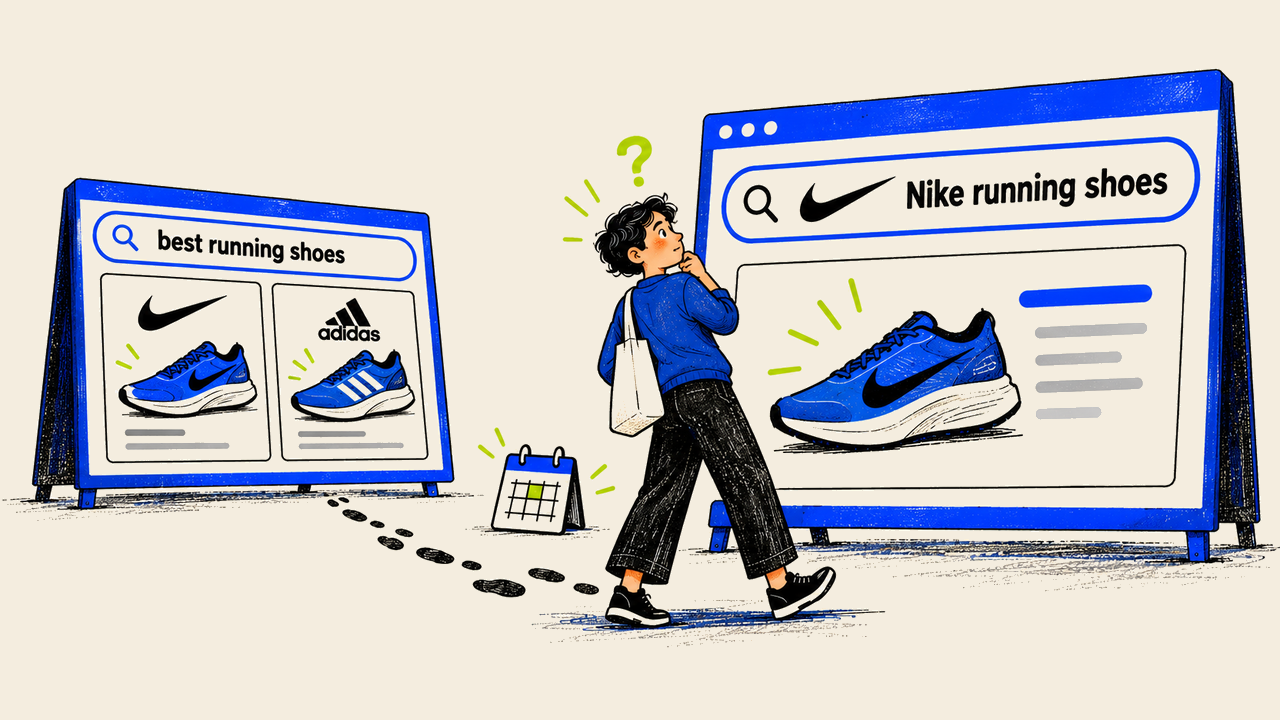
Suppose you need a pair of running shoes. You have a rough budget, a few requirements and no particular loyalty to a brand. So you search for “best running shoes.”
You open a few results. Perhaps an ad takes you to Nike, another to Adidas, and a comparison article introduces a third option. After looking around, you find a Nike model you like. But you are not buying today. Payday is next week, or the card you need is somewhere else, or you simply want to think about it.
A week or a month later, you return to search. This time, you type Nike and the model name.
It would be a little strange to start the whole investigation again. You have already done that part.
The search has changed because you have learned something. A report that sees only the second visit can miss exactly that.
The last search answers a smaller question
“Best running shoes” is a non-branded search: it describes a category without naming the company you will buy from. A query containing Nike is branded, and adding a model makes the destination more specific.
That distinction is useful for understanding what a person is asking for at each moment. It becomes less useful when we treat the final query as a complete explanation of the purchase.
In this hypothetical journey, the customer returns knowing the brand. That does not tell you whether the first ad introduced it, an article made it credible, or a friend's recommendation settled the choice. Nor does a branded query necessarily mean someone is ready to buy. They could be looking for a login, a manual or a return policy.
Still, a purchase report can encourage a very confident conclusion: the branded visit converted, while the non-branded search visit did not. Therefore, only brand search is working.
The first sentence may accurately describe the report. The conclusion asks it to explain much more.
A Google Click Identifier is not a customer identifier
The same thing can happen with software. Someone searches “best project management software,” clicks an ad, compares a few tools and starts a trial. A week or a month later, they search the chosen tool's name, click a branded ad and buy a subscription.
Now suppose someone checks the purchase record and says: “The Google Click Identifier matches a branded ad. That proves where the sale came from.”
It identifies an ad interaction associated with the purchase. It does not establish that this was the customer's first introduction.
With auto-tagging enabled, Google adds a Google Click Identifier (GCLID) to the landing-page URL after an ad click. It is associated with the advertising interaction, rather than being a permanent ID that follows one person through every search. Google's auto-tagging explanation.
In the software example, the first non-branded search ad visit can carry ID A. The later branded-ad visit can carry ID B. The person is the same; the advertising interactions are different. Merely searching does not create a GCLID on your website, and clicking an ordinary organic result does not generate a new GCLID.
There is a technical qualification: repeated clicks on the same ad impression can share an ID. So “a different ID for absolutely every click” would be inaccurate. The point is that the later branded ad is not required to reuse the ID from the earlier non-branded search ad. Google's documentation on click identifiers.
Which ID did the purchase record keep?
This is where the storage method matters. Google's own suggested script for collecting a GCLID stores an incoming ID in a single browser-storage entry. When another valid GCLID arrives, the script writes it to that same entry, replacing the previously stored value. That is one documented implementation, not a claim that every website or Google's entire attribution system works this way. Google's collection example.
If your purchase record is populated from a field that keeps only the latest ID, it could contain B after both visits. Matching B to the branded ad would tell you about that recorded interaction. It would not demonstrate that A never existed. A system preserving the first ID or a history of interactions would give you different evidence, which is why you need to inspect how the field is populated.
The useful follow-up to “I checked the GCLID” is therefore: which interaction does that field retain, and where are the earlier interactions recorded?
Google Ads can report more than a single closing interaction. Its attribution documentation explicitly describes investigating keywords that assisted conversions later completed through other keywords. Checking a connected conversion path is a different exercise from checking one ID on an order. Different GCLIDs do not, by themselves, mean Google has lost the connection between the visits. Google's attribution-report guidance.
If a properly configured path report contains the earlier non-branded search visit, you have evidence to examine its role. If the available records contain only the branded visit, you still need to distinguish between no earlier contribution and no earlier contribution recorded. Neither outcome should be invented to win the argument.
A reporting rule can hide the earlier visit
Attribution is the method used to assign credit for a conversion. Under a last-click model, an earlier visit can receive no credit even when it appears in the recorded journey. Google's paid-and-organic last-click model, for example, generally gives the credit to the last eligible channel while ignoring direct traffic. Other models allocate it differently. Google explains its attribution models here.
So before arguing over the result, I would want to know which report produced it. Is this the source of the purchase session, the customer's first recorded source, or credit assigned by an attribution model? Those are different views of the same business.
There is another distinction worth keeping: a branded search term and a channel labelled organic search are not interchangeable. One describes the words someone typed; the other describes the route they took. A channel report alone does not establish that the person searched the brand name.
The original visit might also be missing altogether. Google documents how an unconfigured journey between separate domains can split one person's activity into separate users and sessions. A product website and a separate checkout need their measurement checked, rather than an assumption that the purchase retained its original source. Google's cross-domain guidance.
Even a connected journey has a time boundary. Attribution lookback windows determine which earlier interactions remain eligible for credit. A customer taking longer to decide can move beyond that window. Google's explanation of lookback windows.
These are reasons to investigate the missing contribution. They do not prove that it exists in every sale.
Non-branded search needs evidence too
It is tempting to fix the argument by reversing it: the non-branded search must have created the customer, and brand search merely collected the payment.
But the running-shoe example is a plausible journey, not a measurement of how often it happens. Someone searching “best running shoes” may already own three pairs of Nike shoes. Another person might discover a product through an ad and never return. An introduction can be useful without being worth its acquisition cost.
The eBay field experiments by Blake, Nosko and Tadelis are a useful complication. Non-branded search ads influenced new and infrequent users, but frequent users absorbed enough spending that average returns were negative. The research gives us a reason to examine customer differences, rather than pronounce all non-branded search spending effective. Read the research.
That is where I would put the discussion: which searches introduce worthwhile new customers, under what conditions, and at what cost?
Follow the decision, not just the final click
For the software customer, the purchase visit is branded while the earlier ad visit came from non-branded search. If that sequence is recorded, examine it as a sequence. If it is not, investigate whether earlier visits were retained and connected before declaring that the non-branded search campaign contributed nothing.
Start by checking the available actual search terms rather than trusting campaign names. An ID matched to a campaign or bid keyword does not automatically establish the exact query someone typed. Google distinguishes the advertiser's keyword from the customer's search term, and some queries are omitted from reporting for privacy. Google's search-term guidance.
Then examine the available paths, time to purchase and first recorded sources alongside the closing visits. Compare new and returning customers where the records allow it, and reconcile purchases with the business's order system. These checks can improve the explanation without pretending they reconstruct every private conversation or visit on another device.
They still leave a budget question: would those customers have bought without the advertising? Observing an ad on the journey cannot settle that by itself. A suitable controlled test can help estimate the additional business the spending produced. Attribution tells us how credit was assigned; the test asks what changed because the ads ran.
For more on the distinction, I have written about overlapping dashboard claims and the value of brand-search ads.
What bothers me about the brand-only conclusion is how quickly it can turn a customer's growing familiarity into evidence against the work that may have helped them choose.
Finding a branded-ad ID beside a purchase can be a valid observation. Treating that one ID as proof that non-branded search advertising played no earlier role goes beyond what the observation establishes.
In the shoe example, the customer comes back with a name because the earlier search helped narrow the options. The second visit is easier to describe. That does not make it the beginning of the story.