
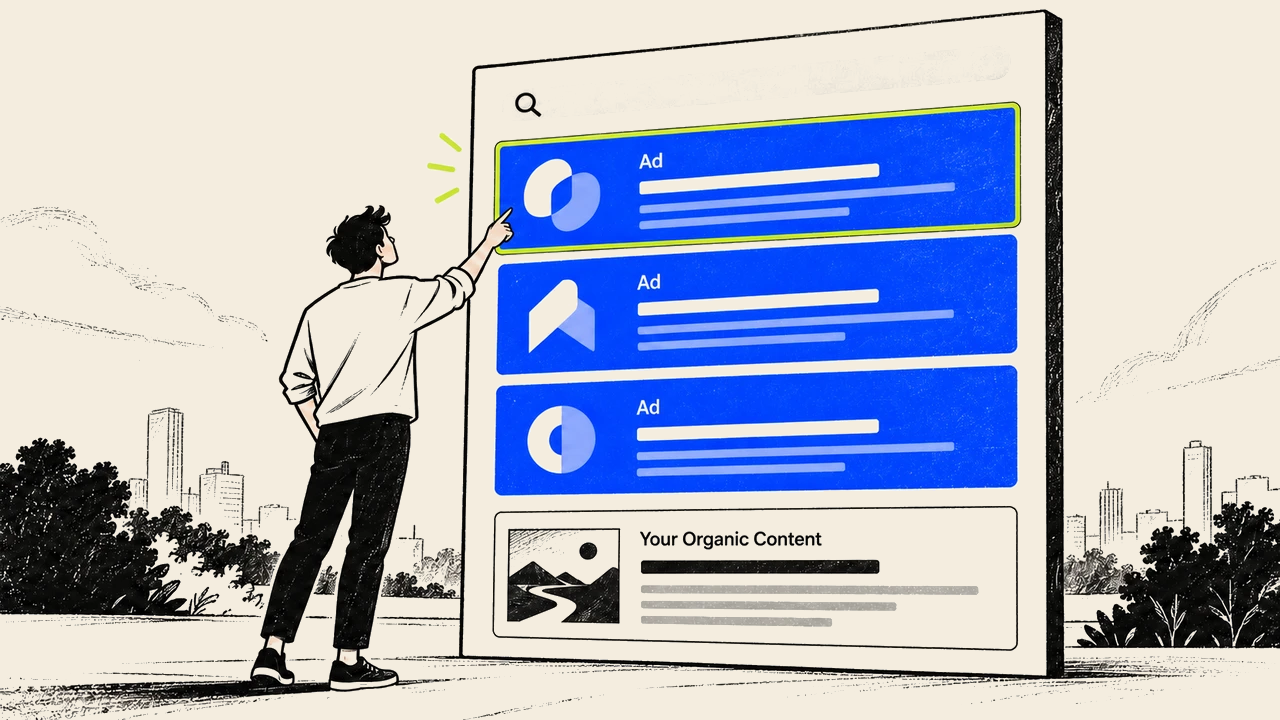
Someone has written an article about choosing a WordPress plugin. It ranks for a relevant search, brings visitors to the website and introduces the company's software.
The company also runs an ad for that search, alongside competitors bidding on the same keyword. Then comes the objection: “Why are we paying for this keyword? Our article already ranks. The ad is taking clicks we would have received organically.”
I understand the concern. Nobody wants to pay for a customer who would have arrived anyway. But the argument has skipped the part where you establish that the customer would actually have arrived.
Your article ranks, but competitors are running ads for the same keyword above the organic results. Before someone reaches your article, they can already see competing software and an invitation to try it. Your organic position gives you a chance to be chosen; it does not reserve that visitor for you.
“Your article already ranks” is not enough evidence to conclude that advertising on the same keyword is unnecessary.
The search result does not belong to you
Imagine someone looking for software to solve a problem. Before they reach your ranking article, they see competitors’ ads above the organic results. Those ads offer other products, other features and other reasons to click.
Removing your ad does not remove those competing ads. It leaves them above your organic result, where the person can encounter their offers before reaching your article. They can open a competitor's product page, start a trial and continue their search from there. They might never see what you wrote.
That is a possible outcome, not a claim that every paid visitor would otherwise become a competitor's customer. But it exposes the assumption in the original objection: that without your ad, the same person would click your article and reach the same decision.
You need evidence for that assumption. A ranking screenshot cannot supply it.
Competitor advertising is a reason to examine what you would lose by withdrawing. It is not a blank cheque to keep every campaign running. The point is that the choice involves the whole search page, rather than only your two listings.
A comparison article and an ad can serve different needs
The competitors advertising above your article are offering a direct route to their software. Your own ad can put your product into that same comparison, while the article serves people who want a longer explanation. Even when the query is the same, the visitor's next question may be different.
One person wants a comparison before choosing software. An article can help them understand the options. Another already knows which features they need and wants to check compatibility, pricing or a trial. An ad leading directly to the relevant product page may give that person a shorter route.
The two placements can also offer different reasons to visit. The article might explain what to consider; the ad might point to a particular feature that matters to the buyer. Sharing a keyword does not make the two experiences identical.
Google's own paid-and-organic reporting guidance treats the listings as something to examine together. It recommends looking at combined traffic and considering how an ad can provide a useful message that differs from the organic listing. That is a more useful starting point than assuming one placement makes the other redundant. Google's guidance.
The research does not support automatic replacement
Google's 2011 search-ad pause research estimated that, across the studies analysed, about 89% of paid clicks were not replaced by organic clicks when ads stopped. It measured additional clicks using observed pauses and a statistical model, not a randomized sales experiment. The percentage is not a forecast for your account. Still, it challenges the assumption that removing ads simply sends the same traffic to free results. The original research.
There is experimental evidence that makes the same assumption worth questioning. At Edmunds, a randomized branded-search experiment found that organic search recovered less than half of the traffic previously arriving through the withdrawn brand ads. The researchers identified competing advertisers as a likely explanation for the missing traffic. They did not track every missing visitor to a rival. Coviello, Gneezy and Goette.
The well-known eBay experiments found no measurable short-term benefit from brand-keyword ads. That contrasting result matters: some paid traffic really can be largely replaced by organic search. It does not establish that replacement will happen for every business. Blake, Nosko and Tadelis.
The Edmunds and eBay findings concern branded searches, rather than the generic software query in this example. None of these studies proves that a particular software campaign is profitable. What they do establish is that organic replacement cannot simply be taken for granted. When competitors are advertising on the same keyword above your article, assuming every displaced paid visit will return through your organic listing leaves their offers out of the explanation.
A later brand search can hide the introduction
There is another way the argument can become misleading. Suppose someone searches for a type of software, clicks an ad and starts comparing products. They choose one, but do not buy immediately. A week later, they return by searching its name and purchase a subscription.
The closing visit is branded. The earlier introduction was not.
If the report gives all the credit to that final visit, it can make the generic ad look unproductive. But the customer returning with a product name does not establish that they knew the name before the first visit. You should examine the recorded journey before dismissing the introduction. Google's attribution documentation explains how different models assign credit to interactions before a conversion. Google's attribution explanation.
This possibility does not rescue a campaign that brings poor visitors at an unsustainable cost. It does mean that “the sale came through brand” and “the generic ad contributed nothing” are different claims.
Cannibalization needs more than overlapping listings
Some paid clicks may indeed replace organic clicks. The article can keep its ranking while the ad attracts someone who would otherwise have clicked it. That is the concern you need to investigate; whether advertising changes organic ranking is a separate question.
But partial replacement does not tell you whether the advertising is wasteful overall. Your ad may attract some people who would have clicked your article and others who would have chosen a competing ad above it. If those additional customers bring enough contribution to cover the spending, some organic overlap can coexist with worthwhile advertising.
The useful question is how total business results change when the tested advertising is reduced or removed. If organic traffic picks up the visits and the business preserves its orders while saving money, there is a case for cutting that spend. If organic replaces only part of the traffic and valuable orders disappear, the ranking article was not doing the same job on its own.
A suitable controlled test can help distinguish those outcomes. It needs a credible comparison, enough data and time for customers to finish buying. Google's geographic-experiment guidance recommends raw conversion or revenue outcomes rather than outcomes already filtered through an attribution model. You need to know what happened to the business, including purchases that moved to another route. Google's experiment guidance.
Until then, ranking is a reason to examine possible overlap. It is not a sufficient reason to stop the ads, particularly when competitors continue advertising on that same keyword above your organic result.
The content team's work can be valuable and the advertising can still have a job to do. You do not have to diminish the article to defend the ad. You do have to stop treating an organic position as proof that the customer was already yours.
Related reading: what brand-search returns leave unanswered and why several dashboards can claim one sale.