
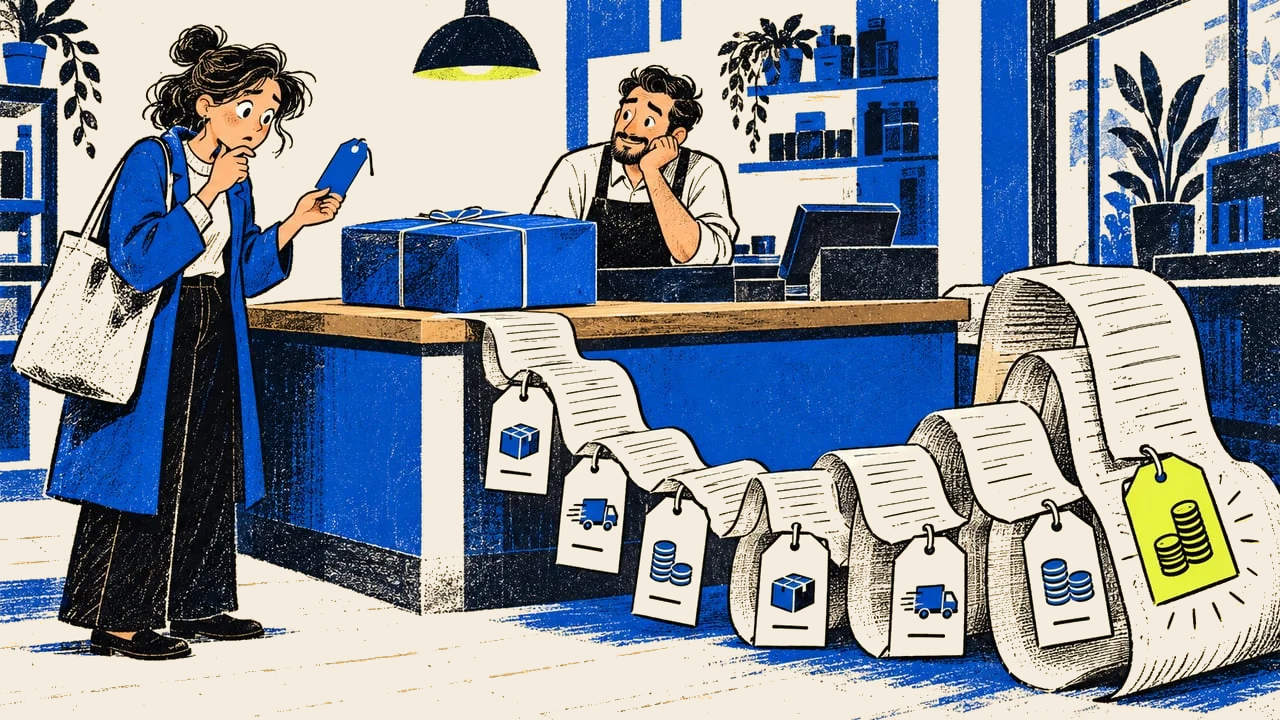
I would like comparing two prices to involve two prices. There may be a good reason one product costs more: better material, a longer warranty, someone taking more care with the work. Those are differences worth considering. Delivery appearing three steps later creates a less interesting kind of comparison.
Imagine choosing a product because it appears to fit your budget. You read the description, check the colour and begin an order. Delivery changes the total. There may be a further charge depending on how you pay. Nothing necessarily makes the purchase unreasonable, but the price you used to make the decision is no longer the price in front of you.
Now you are doing the comparison again, with part of an order already filled in. The product has not changed. The information available when you chose it has. That is why I find “the customer could always leave” an unsatisfying defence of a confusing price.
Expensive and unclear are different problems
Baymard's current checkout-abandonment research lists high extra costs, including shipping, tax and fees, as a reason cited by 40% of respondents in its reasons chart. A separate 12% cited being unable to see or calculate the total upfront. These figures should not be added together or treated as a prediction for an individual shop.
They do help distinguish two complaints that can sound similar. A customer may understand the full price and consider it too high. Another may have been willing to pay it, but could not work out what it was until late in the process. The first raises a question about the offer. The second raises a question about how the offer was explained.
A business can have a good reason for charging delivery. Moving a parcel costs money, and different destinations may cost different amounts. The more useful question is when a customer can discover the effect on their order. A charge that is reasonable in itself can still arrive at an inconvenient point in the decision.
Someone still has to do the work of finding the number
Consider a social post that asks interested buyers to send a message for the price. A custom commission might need that conversation: the dimensions, materials and work involved are not yet known. A fixed product with a fixed price is a different situation. If every interested person needs the same answer, the business has created a repeated conversation to communicate information it already had.
For the fixed product, I struggle to see what the repeated conversation adds. The seller knows the price; the buyer needs it; a message has been inserted between the two. That is my criticism of the practice. The checkout research does not measure private-message pricing or tell us how many orders it loses.
Price ranges can be useful when the conditions are clear. A starting price should help someone understand what is included at that amount. If the example shown requires several upgrades, displaying only the least expensive configuration leaves the reader comparing unlike things.
Explain the cost where the choice happens
For a standard order, I would want the product page to make the likely total understandable before asking for a long form. If an address is needed for delivery, ask for enough location information to estimate it. If free delivery requires a minimum spend, explain the threshold beside the delivery information. Someone should be able to tell whether adding another item would save money or merely increase the order.
Subscriptions need the same care over time. A monthly equivalent, an annual payment and an introductory discount describe different parts of the cost. Putting them close together allows the customer to decide whether the commitment fits their budget. The lowest-looking number on the page is of limited help if the payment due today is somewhere else.
Clarity will not make every price attractive. Some people will see the full cost sooner and leave. That alone would not persuade me to hide it for longer. I would rather understand why a customer rejects an offer they can evaluate than keep counting people who began an order before discovering what it involved.
An expensive offer can still be a clear one. I might decide against it and still understand why someone else would pay. I would prefer that disagreement to reaching the final payment screen and realizing I need to start my comparison again.
Research note
The shopping examples are hypothetical. Baymard's reasons chart reports consumer responses about abandonment; it is not a controlled test of the changes suggested here. Its figures do not establish the effect of private-message pricing, subscriptions or any particular local business practice.