
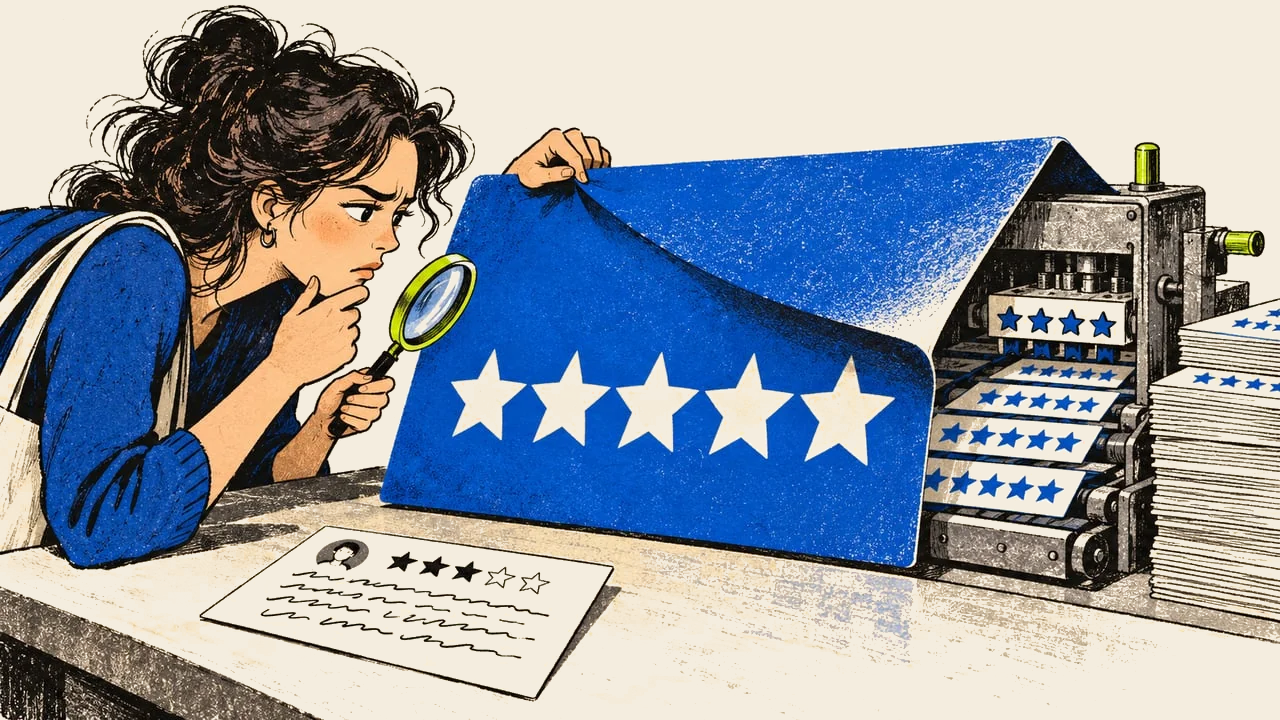
“Excellent quality” is a reassuring thing to read until you try to work out what the reviewer means. Did the bag survive a rainy commute? Did the zip last? Or did it simply look good when the parcel arrived? Five stars let those quite different experiences sit beside one another as though they answered the same question.
Imagine comparing two unfamiliar shops. One has a page full of enthusiastic comments calling the service excellent. Another has fewer reviews, including a detailed account of a late parcel and how the shop handled it. The first looks more flattering. The second might tell you more about the decision you are trying to make.
I would hesitate before choosing on the rating alone. The late-parcel account has given me a situation to think about, including how the shop behaved when something went wrong. That is useful to a buyer even though it makes a less flattering advertisement.
What the rating leaves out
People can give the same rating for quite different reasons. A customer who needed a simple product delivered quickly may be delighted. Someone buying the same product for demanding work may care much more about durability. Without knowing what either person expected, it is difficult to decide how closely their experience resembles the one we are about to have.
This is why a small detail can be more useful than a large compliment. A review describing what fitted inside a bag, how a return was handled or what happened after a month of use gives the next reader something to compare. “Excellent quality” could mean almost anything until someone explains what they noticed.
Even then, detail is not proof of authenticity. A fabricated review can be specific, and a genuine customer may only have time to write a few words. We cannot settle the question by deciding which sentences sound sufficiently human.
An honest seller has to be believed in the same crowded space
In its May 2025 Trust Report announcement, Trustpilot said it removed 4.5 million fake reviews submitted in 2024, representing 7.4% of all submissions. Those are the platform's own figures. They describe reviews it identified and removed; they do not reveal how many remained undetected or establish the rate across the internet.
Still, the scale is enough to make a perfect-looking rating less conclusive than a business might hope. An honest seller is asking a stranger to trust customer feedback in an environment where some of that feedback has been manufactured. Asking for more stars cannot, by itself, resolve that uncertainty.
I can understand the temptation to polish the few reviews a small business receives. Someone has finally said something kind; of course the team wants to present it well. But edit every customer into the same delighted spokesperson and the useful differences disappear. A review that mentions an awkward strap or an initially confusing setup may explain the experience more convincingly than another sentence of praise.
Let the customer explain the experience
If I were asking for feedback, I would rather learn what someone bought, what they needed it for and whether it did the job. A specific question gives a willing customer something to discuss without supplying the verdict for them. It also allows a disappointing experience to surface while the business still has a chance to understand it.
With permission, a testimonial can preserve those circumstances instead of trimming everything down to a line of praise. If the reviewer received a free product or another benefit, that context belongs with the account. A reader should be able to understand the relationship behind the recommendation.
I would also want the claims on the product page to carry some of the burden. Measurements, clear photographs, limitations and an understandable returns policy give people evidence they can examine alongside other customers' opinions. Reviews are more useful when they help interpret that information than when they are expected to replace it.
A detailed account can still be fabricated, and an honest customer may write very little. I would not turn a preferred writing style into an authenticity test. What a business can do is leave the experience recognizable: what someone needed, what happened and what remained imperfect. Give me enough of that and I can decide whether their five stars mean much for the bag I need to carry tomorrow.
Research note
The two shops are hypothetical. The Trustpilot finding is a dated, self-reported enforcement figure, not an independent estimate of all fake reviews. The recommendations are editorial analysis, rather than interventions tested by that report.