
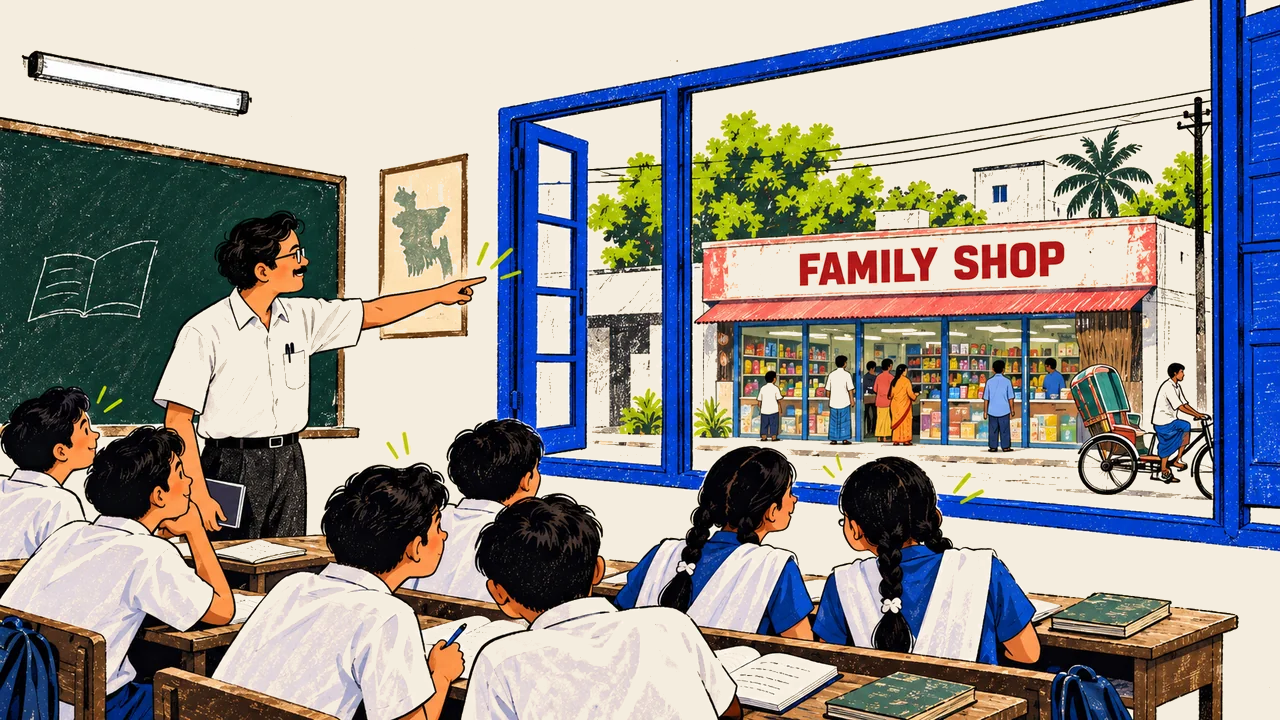
Nearly two decades ago, I was a Class Eight student at a school in a district town in Bangladesh.
One day, the math teacher failed to show up. Instead, our Bangla teacher walked in to take the period.
We were delighted. A missed math period usually meant an easy, entertaining session. We expected stories, jokes, maybe a relaxed discussion. What we did not expect was a question that would leave the whole class silent.
After taking attendance, Sir looked at us and asked:
“Tell me, what do you think the Family Shop across from the school is worth? You do not need an exact figure. Just give me a reasonable estimate.”
For a moment, nobody said anything.
The Family Shop was huge. How were we supposed to put a price on it? We started doing what Class Eight students naturally did. We tried to calculate the value of everything inside. The shelves, groceries, toiletries, household items, furniture, and whatever else we could remember seeing there.
One by one, we offered our estimates.
One by one, Sir rejected them.
The more we tried, the more confused we became. Sir, meanwhile, watched us struggle with a small smile. Finally, near the end of the class, he explained what we had missed.
At the time, our town did not have supermarket chains like Shwapno, Agora, or Meena Bazar. Family Shop was our supermarket. It was the place where people went for almost every daily necessity. Everyone knew it. Everyone trusted it. It had built a reputation across the town.
That reputation was the answer.
We had tried to calculate the value of the products inside the shop. But Sir wanted us to think beyond the inventory. He wanted us to understand that a business can be worth far more than its shelves, inventory, cash, or building.
When a company earns public trust over time, its name becomes a brand. That brand has value of its own.
If someone bought Family Shop, they would not simply be buying its products and physical assets. They would also be paying for its reputation, the trust people had in it, and the established habits that brought customers back through its doors.
That trust would not guarantee that every customer stayed. If the new owner allowed quality or service to decline, people could choose to shop elsewhere. But as long as the standard remained intact, the goodwill built over the years would continue to create value.
That was Sir’s lesson: a company’s real worth is not limited to what it owns. It also includes what people believe about it.
A strong brand can take years to build, but it can make a business far more valuable than the sum of its physical parts. When you buy an established company, you are not just buying a business. You are buying the goodwill it has earned.