
Adapted and expanded from my Roar Bangla article, “From Tango to Jabulani: The Evolution of World Cup Footballs”, originally published on 14 November 2022.
30 July 1930. Estadio Centenario, Uruguay.
The gates opened that morning. By noon, the stands were packed. In just a few hours, the first final in football World Cup history would begin.
But before kick-off, there was a small problem.
Who would supply the match ball?
Argentina and hosts Uruguay both insisted on using their own. Neither wanted to play with the other team’s ball. FIFA eventually had to intervene.
The compromise: Argentina would supply the ball for the first half, Uruguay for the second.
Both teams agreed. Neither could have known how dramatically the afternoon would unfold.
Argentina’s ball, the Tiento, went into play first. By half-time, Argentina led 2–1.
After the break, Uruguay’s T-model took its place.
Uruguay seemed to catch fire. They equalised in the 57th minute, took the lead in the 68th, then scored once more in the 89th.
From 2–1 down to a 4–2 victory, Uruguay became the first World Cup champions.
The change of ball alone cannot explain the comeback. But the dispute tells us something about the tournament’s early days: even the object at the centre of the game was something the teams had to argue over.
Four decades later, Adidas would begin turning that object into one of football’s most recognisable brand associations.
Why did FIFA choose Adidas?
The familiar black-and-white pattern explains why people remember Telstar. But why was Adidas given the job in the first place?
According to Adidas’s own account, FIFA appointed the company as its official match-ball supplier in 1970 to improve consistency and the standard of play. Previously, the choice of ball had generally fallen to the host country. The appointment gave the tournament a continuing equipment supplier.
That answers the need FIFA wanted to address. It does not fully explain why Adidas was selected over another manufacturer. The historical accounts linked here do not set out competing bids or FIFA’s full selection criteria. Television visibility was a benefit of Telstar’s design; it would be a leap to present it as the sole reason Adidas won the appointment.
For the marketing story, that distinction matters. Getting selected as the supplier gave Adidas access to the World Cup. The product’s recognisable design and the continuing partnership helped the company build on that access.
Telstar was designed for the audience watching at home
Television gave the football another job: it had to remain visible to people watching on a screen.
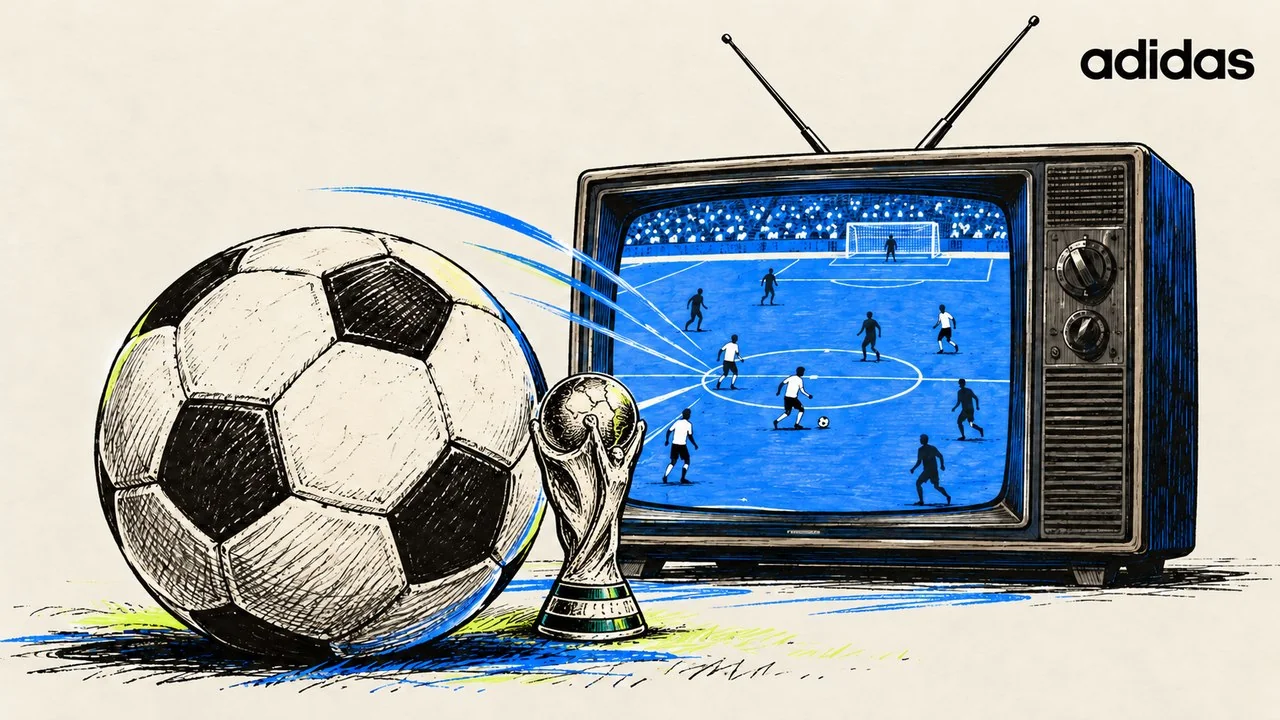
Adidas’s answer was Telstar, with 12 black pentagons and 20 white hexagons. The contrasting panels helped viewers follow the ball on black-and-white televisions. Adidas identifies that visibility as a central feature of its first official World Cup match ball in its company history.
There is a useful marketing lesson in that decision. The product’s appearance addressed a practical problem created by the way people experienced the game.
Players needed a ball they could use on the pitch. Viewers needed one they could follow from their living rooms. Telstar’s design connected those experiences.
The resulting pattern became recognisable far beyond that particular tournament.
The branding became part of the product
The relationship developed further in 1974. The official balls carried the manufacturer’s branding, the ball’s name and the tournament designation. FIFA’s match-ball history documents that change.
From a brand perspective, that is a remarkable position to occupy.
A football appears throughout a match. Cameras follow it. Players chase it. Photographers capture it at the moment a goal is scored.
Supplying the ball places a company’s product inside the action people have gathered to watch. Its visibility comes from its function.
That gives the partnership a particularly close connection to the sport.
Every tournament offered another chapter
Telstar was followed by names such as Tango, Azteca, Tricolore, Teamgeist and Brazuca. Different designs gave successive tournaments their own visual identity, while the supplier remained familiar.
FIFA confirms that Adidas has supplied the official match ball for every men’s World Cup since 1970 in its partnership overview.
My reading of that continuity is that each tournament offers two opportunities at once: introduce something new and reinforce an existing association.
A supporter might remember a ball through a favourite team, a particular goal or the summer they first followed football closely. A new edition can therefore become both a product and a marker of time.
Over successive tournaments, those associations accumulate.
What a smaller brand can take from this
Most businesses will never supply a World Cup ball. But the relationship between the product and the event offers a useful question:
Where could your product become useful enough that people repeatedly encounter it doing its job?
For a software company, that might mean helping a professional community solve a recurring problem. A design tool could support a workshop series. A forms plugin could power registrations for an industry event. The audience gets something useful, while the product gets used in a relevant setting.
The fit matters. A large audience has limited value if the people attending have little reason to use what you sell.
Make the connection recognisable
Useful participation needs a clear identity. Consistent visual elements, language and presentation give people something to recognise the next time they encounter the brand.
A smaller company can apply that principle to a recurring tutorial series, an annual report or a community event. Each edition should feel connected to the previous one, even as its subject changes.
Give repetition a reason to exist
A continuing partnership creates opportunities to improve the experience. The questions people ask, the problems they encounter and the ways they use the product can inform what comes next.
Before renewing a sponsorship, I would want to know whether the previous activity reached relevant people, led to meaningful product use and created a reason for those people to return. Familiarity is useful, but it needs to support the business.
Measure the outcome you actually need
For a smaller brand, I would look beyond logo exposure. Depending on the goal, useful measures might include qualified visits, activated users, enquiries, repeat participation or customers who mention the partnership.
Those measures would help decide whether to continue, improve or stop the activity.
The practical lesson I take from Adidas is to find a relevant setting where the product can contribute, make that contribution recognisable, and build on it consistently. A modest partnership can be valuable when the audience, product and purpose fit together.
What “taking over” really means
Here, “taking over” refers to Adidas’s enduring position as the official World Cup ball supplier. It is a story about a specific partnership, rather than a claim about the entire football market.
The interesting part is how product design and commercial continuity support each other.
Telstar addressed a viewing problem. Later editions brought new designs and technical developments. The recurring partnership kept Adidas connected to the same global sporting occasion.
For marketers, the lesson is worth considering: a brand can build a powerful association by becoming useful within an experience people already care about.
Adidas supplied the object around which the whole match revolved. Decades of World Cups gave that relationship time to become familiar.
Original reporting: This article develops the brand-strategy angle of my earlier Bangla feature published by Roar Bangla. Historical details have been checked against FIFA and Adidas sources; the marketing interpretation is my analysis.