
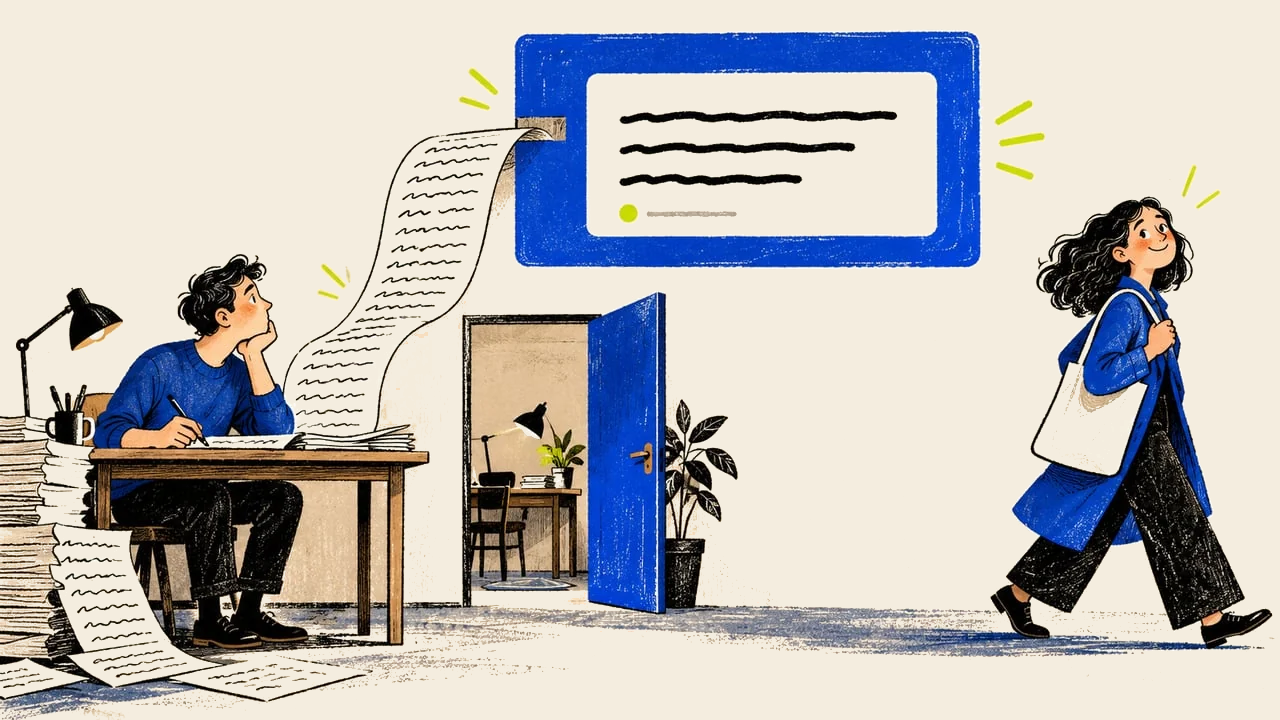
A clear answer can leave its writer with an awkward result: the reader no longer needs to visit. The explanation has done its job somewhere in a search result, while the article that supplied it waits for an audience. As a reader, I understand the convenience. As someone interested in making content worth publishing, I find the arrangement harder to be cheerful about.
For someone looking up a simple definition, that can be a good experience. They did not necessarily want a new publication to follow or several related articles to read. They wanted an answer. For a business paying to research and publish that answer, the same interaction can be much harder to justify.
I do not think the reader owes an article a visit for answering a simple question. That leaves the publisher with a more demanding editorial decision: what is the rest of the page actually for?
Being cited is not the same as being visited
Pew Research Center analysed browsing data from 900 US adults and examined Google searches made in March 2025. Traditional result links were clicked on 8% of visits where an AI summary appeared, compared with 15% of visits without one. Links inside the summaries themselves received clicks on 1% of visits with a summary.
These are observations from a particular period and sample. They do not prove that the summary alone caused the difference: the questions people ask and the kinds of results they receive also matter. They do make it difficult to assume that a citation will regularly deliver a reader to the source.
That distinction matters when deciding what a blog is supposed to achieve. A reference to a business may have some value even without a visit, but a source link does not tell us whether the reader noticed the name, remembered it or later considered buying something. Those are separate questions requiring their own evidence.
What would I miss by staying in the search results?
Suppose someone searches for a definition of customer lifetime value. If a short explanation settles their question, making the article twice as long is unlikely to give them a compelling reason to open it. A worked example using a business model they recognise could serve a different need. So could a calculator that lets them explore their own numbers.
The useful difference is what the reader can do or understand after arriving. Length on its own explains very little. A long introduction may simply delay the answer they came for.
I am more interested when an article lets me examine a decision. Why did a team choose that measure? What did it leave out? What did they give up by choosing the cheaper option? Those details give me something to argue with, which is a better reason to keep reading than a definition padded with an elaborate introduction. A disagreement can be useful; another paragraph saying that the subject is important usually tells me very little.
I would not promise that originality protects a page from being summarised. It does not. An original observation can also be extracted, and producing a detailed article is no guarantee of traffic. But it gives us a better editorial question than asking how to stretch a familiar answer into another post.
What is worth publishing anyway?
Some straightforward explanations are still worth keeping. Existing customers may need them, colleagues may send them in reply to questions, and a clear reference page can save repeated work. Their usefulness need not depend entirely on how many strangers arrive from Google.
Other articles are written to introduce the author's judgment. For those, I would want to see an argument, evidence and a reason to remember who is explaining it. A reader following a recommendation from a colleague should encounter something more particular than information they could have found in dozens of places.
This would also change the questions I ask of a content report. Alongside visits, I would look at whether people return, explore relevant work or begin useful conversations. None of those measures replaces revenue, and a quieter traffic chart is not automatically evidence of better visitors. They help examine whether the writing is doing the job chosen for it.
Some questions really are finished in a few sentences. I would rather publish those sentences as a useful reference than dress them up as a major feature. For the longer article, I want a reason to stay after finding the answer: a decision to examine, an example to work through, or a perspective I might remember the next time the problem appears.
Research note
The definition and calculator example is hypothetical. Pew's July 2025 report describes US browsing observed in March 2025, rather than present-day worldwide click rates or a causal experiment. The editorial suggestions are interpretations of the publishing problem, not ranking or traffic guarantees.